

Spain & Europe Travel
V-16 Emergency Beacons.
Overview
If you're touring Spain in your motorhome, there's a new bit of kit worth knowing about: the V-16 connected emergency beacon. Spain has overhauled its roadside breakdown rules, and while the change is aimed at Spanish-registered vehicles, there are good reasons for UK visitors to get on board too. Before travelling abroad, it's also worth checking the European cover provided by your motorhome insurance .
What's Changed in Spain
From 1 January 2026, connected V-16 beacons became the only legal device for signalling immobilised vehicles on Spanish roads, replacing the traditional red warning triangle.
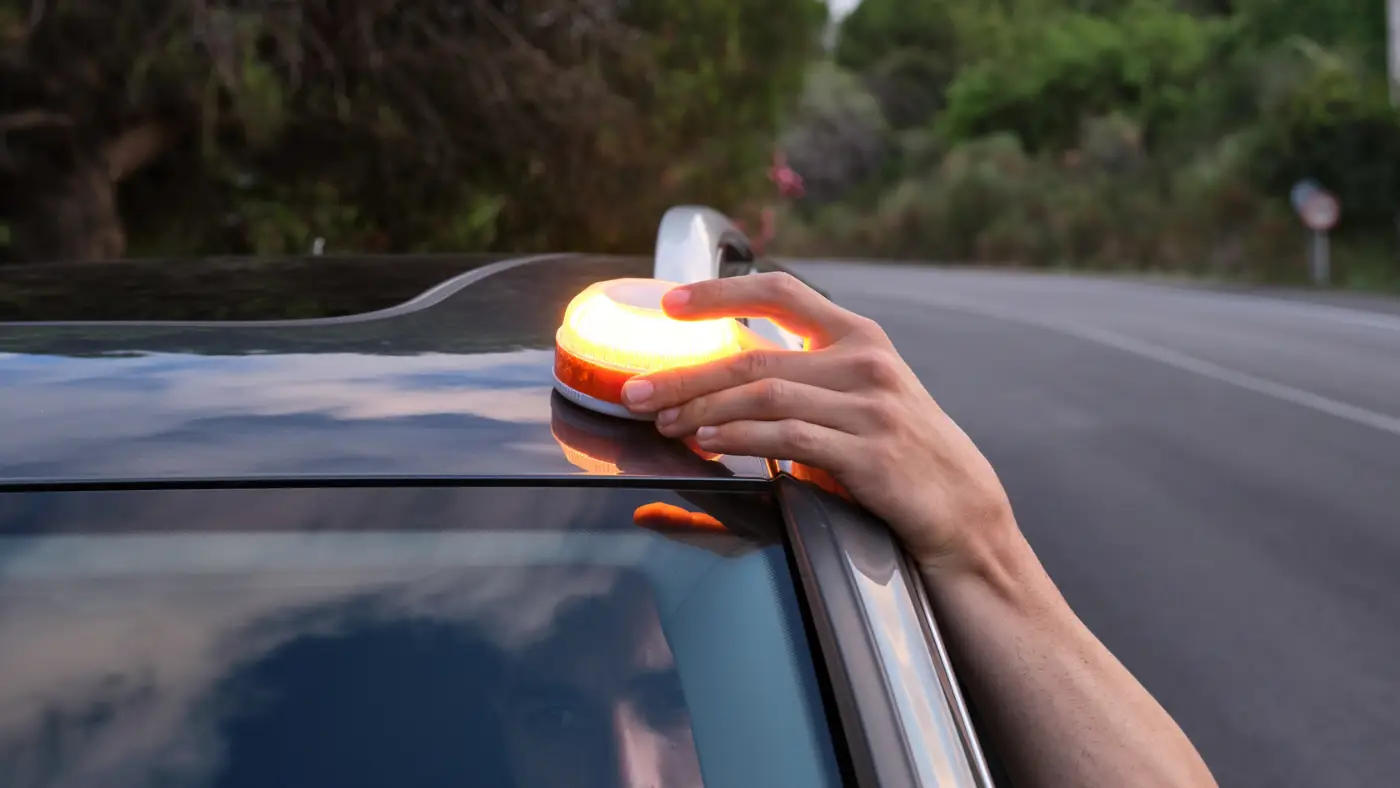
Unlike the reflective triangle most of us have carried in the boot for years, the V-16 is a small, magnetised amber light. It's compact, 360-degree, and emits a high-intensity intermittent light visible up to 1km away in good conditions, flashing at between 40 and 80 candelas.
The key innovation isn't just the brightness — it's that you never have to leave your vehicle to use it. You activate it and place it on the roof by lowering your window and reaching up from inside, rather than stepping out onto a live carriageway. Traditional triangles require walking up to 50 metres along the road to place them, often on motorways or in poor visibility, which has long been recognised as one of the more dangerous parts of dealing with a breakdown.
The Technology Behind It
There's also a tech layer most people don't expect from what looks like a simple hazard light. The beacon transmits the vehicle's location to Spain's DGT 3.0 traffic platform, which then displays the information on roadside panels and GPS devices to help manage traffic around the incident.
Each unit includes a non-removable SIM card and GPS chip for this purpose. Spanish authorities have confirmed it doesn't track your movements generally — it only transmits when activated, and it isn't automatically linked to emergency services.
Do UK Visitors Actually Need One?
Here's the important bit if you're touring in a UK-registered motorhome: you're not legally required to switch. The mandate applies to Spanish-registered vehicles, and visitors can still use their home country's warning triangles. Foreign-registered vehicles can continue using triangles, which remain recognised even though they've lost legal validity for Spanish-plated cars.
So you won't be fined for touring Spain with your existing UK triangle kit. But "not required" isn't the same as "not worth having."
Why UK Motorhome Owners Should Consider One Anyway
It's simply safer, especially for a motorhome. Getting a warning triangle 50 metres down a Spanish autovía with lorries thundering past is unpleasant enough in a car — in a motorhome, where you're likely tired, possibly with family aboard, and not as nimble getting in and out, it's worse. The whole point of the V-16 is eliminating the need to exit the vehicle on high-speed roads, the single most dangerous part of a roadside breakdown. It's one of several safety items worth considering alongside the equipment in our essential motorhome accessories guide .
Better visibility in bad weather. The beacon can be seen from up to 1km away, significantly further than a standard triangle, especially in rain or poor visibility — which matters a lot on Spanish motorways where speeds are high and weather in mountain regions can close in quickly.
Faster, safer recovery. Because the beacon automatically shares your location with Spanish traffic authorities, recovery services can find and reach you more quickly and safely — useful if you've broken down somewhere unfamiliar or hard to describe over the phone.
It's likely coming to more of Europe. It's considered highly likely the V-16 scheme will be rolled out more widely across the EU in the coming years. If you regularly tour France in your motorhome , Portugal, or further afield, buying one now means you're ahead of the curve rather than scrambling to source a compliant one later.
Prices are only going one way. As with most equipment like this, the cost is likely to only increase over time as more countries adopt the requirement, so there's a reasonable case for buying sooner rather than later if you're a regular Spain or Europe tourer.
What to Look Out For When Buying One
Only "connected" (geolocation-enabled) beacons are compliant with Spanish law — basic V-16 lights without geolocation lost their legal validity for Spanish vehicles from 31 December 2025. Certification matters too: beacons must be certified by IDIADA or LCOE, the authorised Spanish laboratories confirming a device meets the required safety standards.
Watch for fakes. With the deadline having passed, the market has been flooded with cheap, non-compliant devices, and buying the wrong one can mean a fine as well as reduced safety in an actual breakdown. The DGT has already withdrawn approval from several beacon models in the early weeks of the rule being in force, so it's worth double-checking a model's current approval status rather than trusting older reviews or listings. Only devices carrying a testing laboratory mark and a visible identification number are authorised for use.
Where to Put It (and How to Use It)
For motorhomes specifically, roof placement needs a bit of thought given the size and shape of most vans.
The beacon should ideally go on the roof, but if the roof is unsuitable — for example aluminium or glass — suction-cup models or placement on the driver's door or chassis arch are recommended alternatives. For larger, high-bodied vehicles, it can be placed on the rear exterior if it's safe to exit the vehicle to do so. This is worth bearing in mind for coachbuilt or A-class motorhomes where the roofline is higher and harder to reach than in a car.
Keep it accessible, not buried in a locker: it should be stored somewhere easily reachable, such as a convenient storage compartment, without needing to get out of the vehicle to retrieve it. Checking that safety equipment is present and accessible is also worth including in your motorhome pre-departure checks before setting off on a European trip.
The Bottom Line
UK motorhome owners touring Spain aren't legally obliged to carry a V-16 beacon — your existing triangles remain valid for foreign-registered vehicles. But given the genuine safety advantage of never having to step out onto a live carriageway, the improved visibility in poor weather, and the likelihood that similar rules will spread across Europe, it's a small, one-off purchase that's hard to argue against for anyone who regularly tours the Continent.
If you do buy one, just make sure it's a certified, connected model — the cheap unconnected imitations flooding the market right now won't do you any good if you actually need it.
Written by Nicky Michelmore